
























Small business · Year-end giving
Year-end giving appeal printing: the pieces that get read
A year-end giving appeal lives or dies at the reply card. Here's what goes in the package, what to print each piece on, how many to order, and the 2026 dates that get letters into mailboxes before Thanksgiving.
 By Mike & Erin · · 7 min read

Most year-end giving appeals that come up short don't fail in the letter. They fail at the reply card. The card has no room for an email address, it doesn't fit the return envelope, or the only mailing address is on the letter the donor already recycled. The donor meant to give. The pieces made it hard.
We're Honor Printing + Design, a family-run print and design shop in the Atlanta area. We do printing for nonprofits and small businesses, churches and schools, and we ship nationally. This guide covers what goes in a year-end giving appeal package, what to print each piece on, how many to order, and the 2026 dates to work back from so gifts arrive before December 31.
What goes in a year-end giving appeal package?
Four pieces go in the mail: an outer envelope, the letter, a reply card and a return envelope. A fifth piece, the thank-you card, goes out after the gift. Each one has a single job.
| Piece | Its job | Print it on | Common mistake |
|---|---|---|---|
| Outer envelope | Get opened | A standard #10 envelope (4 1/8" x 9 1/2") | A teaser line that asks for money before anyone has read why |
| Letter | Tell one story, make one ask | One or two pages of plain, uncoated letter paper | Three stories, two signatures, and the ask buried on page two |
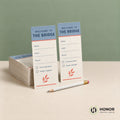
| Reply card | Capture the gift | Uncoated card stock that takes a ballpoint pen | Glossy stock that smears, and no space to write an email |
| Return envelope | Bring the check back | A #9 envelope (3 7/8" x 8 7/8"), pre-addressed to you | A reply card too big to fit without folding |
| Thank-you card | Keep the donor for next year | A 5" x 5" or 5" x 7" card, uncoated so it can be signed by hand | Printed after the gifts arrive, so it goes out in February |
The #9 return envelope is the quiet hero here. It slides inside a #10 without folding, so the whole package stays flat. Size the reply card to fit the #9: a card about 3 1/2" x 8 1/2" drops in with room to spare.
What should a year-end reply card say?
Everything a donor needs to give without the letter in front of them. Picture the card on a kitchen counter a week later, next to a checkbook. The letter is gone.
The reply card has to work on its own. Put your organization's name, mailing address and giving page on the card itself, not only on the letter.
A reply card that works has these, top to bottom:
- Your organization's name and mailing address. If the return envelope gets lost, the card still tells them where to send the check.
- The donor's name and address, printed or on a label, so they don't have to write it again. Leave a line to correct it.
- Three or four gift amounts plus "Other". Base them on what your donors gave last year, not on round numbers you like.
- A checkbox for monthly giving. One line, no pressure.
- A line for an email address, so the thank-you and next year's update can reach them for free.
- A short web address or QR code for giving online. Test it from two different phones before you approve the proof.
- Who to make the check payable to, spelled exactly the way your bank needs it.
Keep the back of the card for one sentence that repeats the ask in the letter's own words. Don't add a second story.
What paper should a giving appeal be printed on?
Plain paper for the letter, uncoated card stock for anything someone writes on. That's the whole rule.
A letter on plain, uncoated paper reads like a letter from a person. Heavy gloss reads like a brochure, and some donors will wonder what it cost. Save the coated stock for an annual report or an event program, where photos matter more.
The reply card and thank-you card need to take ink from a ballpoint pen. Coated gloss and matte stocks can smear or skip. Our postcards come in 4" x 6", 5" x 7" and 8.5" x 5.5", with a 14 pt uncoated stock made for writing on. If you want a reply card in the long #9-friendly size, ask us and we'll quote it.
When should a year-end appeal mail in 2026?
Get the letter into mailboxes before Thanksgiving week, then send one short follow-up in mid-December. Holiday mail gets crowded, and a letter that lands with the Christmas cards is easy to set aside.
In 2026, Thanksgiving is Thursday, November 26. GivingTuesday is the Tuesday after, December 1. December 31 is a Thursday. Here are planning dates for your side. They are not a promise from any printer, so confirm timing when you order:
| Aim for | What's done |
|---|---|
| Friday, October 23 | One story chosen, one ask decided, mailing list pulled and cleaned |
| Monday, November 2 | Letter and reply card copy final; one person signs off |
| Friday, November 6 | Printing ordered: letter, reply card, envelopes and thank-you cards together |
| Friday, November 20 | Letters in the mail |
| Tuesday, December 1 | GivingTuesday: an email that points back to the letter |
| Monday, December 14 | Follow-up postcard to anyone who hasn't given yet |
| Thursday, December 31 | Last day for 2026 gifts |
If you plan to mail at nonprofit postage prices and don't yet have USPS authorization, apply now. Under the USPS nonprofit mailing rules, you pay regular Marketing Mail prices while the application is pending. If it's approved, USPS can refund part of the difference, so keep your postage records. Nonprofit Marketing Mail also travels slower than First-Class Mail, so give it extra days.
The return envelope keeps working right up to the last day. The IRS treats a check as given on the date it's mailed, so a check mailed on December 31 counts for 2026 even if it reaches you in January.
How many should you print?
Print the letter, reply card and envelopes to your mailing list, plus about 5% for spoiled pieces and the office file. Print thank-you cards for the whole list, not the donors you expect. You'll use the leftovers in spring.
Quantity pricing usually makes ordering up cheap. As of October 2026, 500 of our 4" x 6" postcards are listed at $89 and 1,000 are $99. The jump from 500 to 1,000 costs $10. For an appeal list of 700 households, ordering 1,000 follow-up postcards is the better buy.
What do donors need from you after they give?
A thank-you within a few days, and for larger gifts, a written acknowledgment for their taxes.
Under IRS rules, a donor needs a written acknowledgment from your organization to deduct any single gift of $250 or more. If a donor got something back for a payment over $75, such as a dinner ticket, you owe them a written disclosure with a good-faith estimate of its value. The IRS lays out both rules in Publication 1771. We're printers, not accountants, so have your treasurer or accountant confirm the wording.
The printed piece can carry the warmth. A hand-signed 5" x 5" card on uncoated stock, mailed in the first week after the gift, is a thank-you that feels like it came from a person. The receipt can ride along with it or follow by email.
Should you mail to new neighbors too?
Usually not in the same package. A year-end appeal works best with people who already know you: past donors, volunteers, event guests. People who have never heard of you need an introduction before an ask.
If you want to reach a whole neighborhood, that's a different mailer with different rules. Our Every Door Direct Mail guide was written for churches, but the sizes, postage and drop-off steps work the same for any nonprofit.
How Honor helps with a year-end appeal
Send us what you have: a letter draft, last year's reply card, or just the story and the number you're trying to raise. We'll design the reply card and thank-you card to match the letter and quote the whole package together. You'll approve a proof of every piece before anything prints. Tell us your list size and the date you want letters in mailboxes, and a real person will reply with a quote within 24 hours, Monday to Friday. Start a year-end appeal quote.
Should we send the appeal by mail or email?
Both, in that order. The letter does the asking, and the email on GivingTuesday or in mid-December points back to it. Some donors who read a letter would rather give online, which is why the reply card should carry your giving page address. An email-only appeal is cheaper, but it's also easier to delete without reading.
What's the difference between a return envelope and business reply mail?
A plain return envelope asks the donor to add a stamp. Business reply mail is a USPS service where the envelope carries a special printed design and you pay postage only on the envelopes that come back. It needs a USPS permit and an approved layout, so set it up well before you print.
Should the letter be one page or two?
As long as the story needs and no longer. A one-page letter with one clear story usually beats two pages of program updates. If you go to two pages, put the ask on page one too, so a skimmer still sees it.

Keep reading
More guides from the shop

Holiday sale signs for small businesses: what earns its cost
The holiday signs worth paying for are the ones you can use again. Here's which to buy, what each one should say, and when to order so they're up before Thanksgiving weekend.

Mesh vs vinyl banners: choosing by where it hangs
Wind decides between mesh and vinyl, sun decides between 13 oz and 18 oz, and light decides between vinyl and fabric indoors. Here is the right banner material for fences, walls...

Church Christmas printing checklist for 2026
Every piece a church prints for Christmas, the order to lock them in, and the 2026 dates to work back from. Plus the rule that saves your banner for next year: dates go on paper...